
Title 24's solar requirement and how carports count toward it
The 2025 California Energy Code took effect January 1, 2026. New nonresidential buildings and multifamily buildings of three or more stories must include a PV system, and the roof area of carports and covered parking counts toward the solar area that sizes it. What that means for developers and owners.
6 min read · Updated October 6, 2026
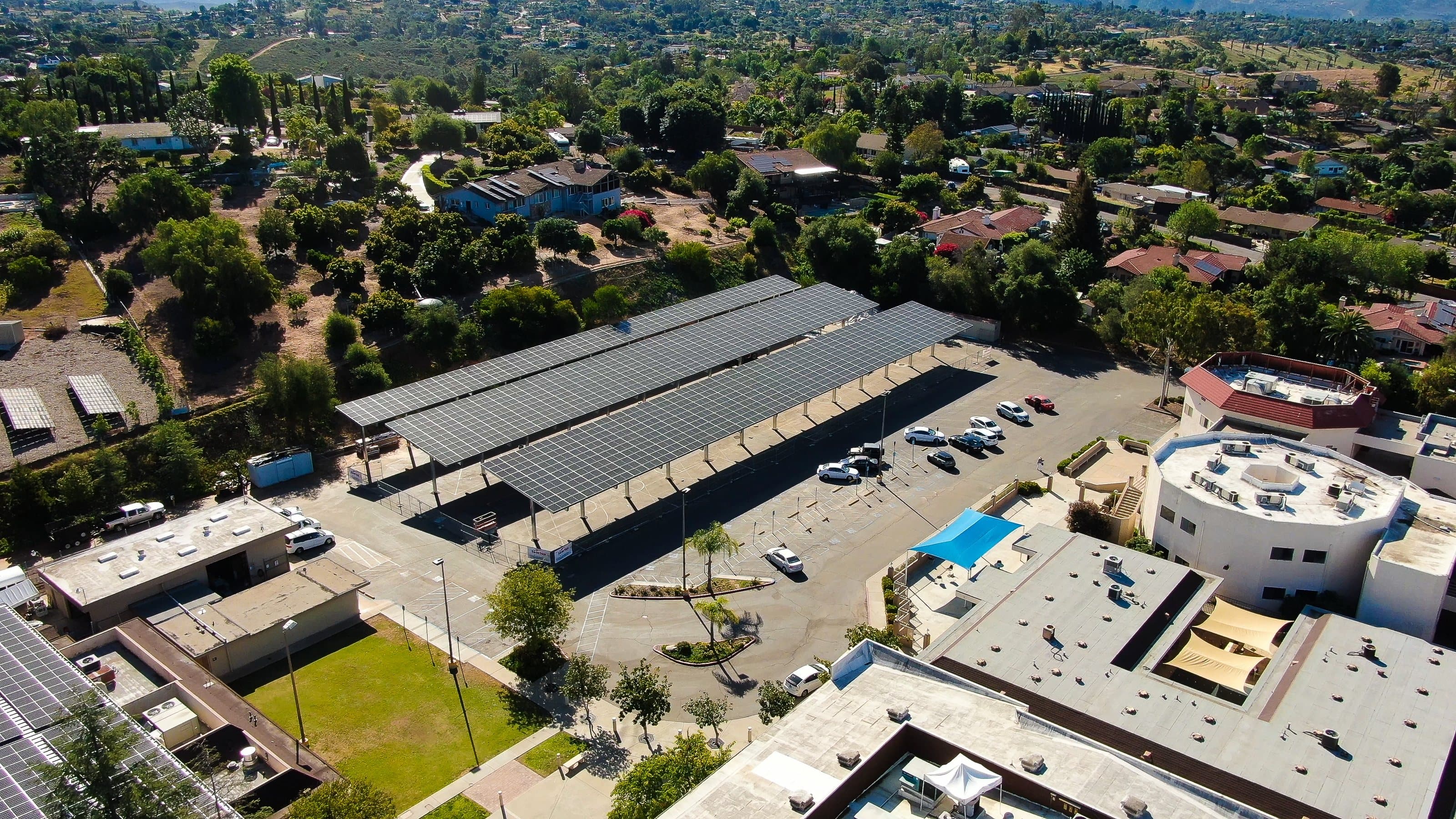
Since January 1, 2023, California's Energy Code has required photovoltaic systems on most new nonresidential buildings and on multifamily buildings of three or more stories. The 2025 edition of the code, which applies to permit applications submitted on or after January 1, 2026, carries the requirement forward with updated building types and battery provisions. For anyone developing a commercial or multifamily project, the question is no longer whether to include solar but where to put it, and that is where the parking lot comes in.
Who the requirement covers
Section 140.10 of the 2025 Energy Code requires a PV system, and in most cases a battery storage system, for newly constructed nonresidential buildings where at least 80 percent of the floor area falls into the building types listed in Table 140.10-A. The list includes offices, retail and grocery, warehouses, schools, libraries, hotels and motels, restaurants, religious worship, sports and recreation, events and exhibits, and multifamily buildings with three or more habitable stories. Mixed-occupancy buildings are covered when the listed uses make up the required share of the floor area.
How the system is sized, and where carports come in
The required PV capacity is calculated from the building's conditioned floor area and type, using a kilowatts-per-square-foot factor from the code table. The code then compares that requirement to the site's Solar Access Roof Area, or SARA, which is the roof area that is unshaded and able to support PV. The important detail for parking lots is in the definition of SARA: it includes the roof area of covered parking areas, carports, and all other newly constructed structures on the site that are compatible with supporting a PV system.
That definition cuts two ways. If a project builds carports, their roof area is added to the SARA and can raise the PV requirement. More usefully, when a building roof cannot carry the required system, because it is small relative to the floor area, heavily shaded, or taken up with mechanical equipment, the carport roof is where the required capacity can go. A canopy over the parking lot is a code-compliant location for the PV the building must have.
The exceptions
The code provides exceptions that reduce or remove the requirement, including when the SARA is very small, when the available area is shaded by adjacent structures or terrain, and when the required system would be smaller than a minimum threshold. Each exception must be documented in the compliance forms. A carport does not change the exception analysis for the building roof, but it does change the answer to "where can the system go" once the requirement is established.
Battery storage
The 2025 code pairs the PV requirement with a battery storage requirement for most covered building types, sized from the PV capacity. Canopy projects can host the storage as well; the equipment is placed at grade near the service or integrated into the charging infrastructure when EV charging is part of the project.
What this means for a developer
- Run the Section 140.10 calculation at schematic design, not at permit. Knowing the required kW early lets the architect decide between roof and canopy while the site plan is still moving.
- If the roof is constrained, design the canopy into the parking layout. Column lines, drainage, and lighting all get simpler when the canopy is part of the civil drawings.
- A canopy also satisfies CALGreen's EV-ready requirements more cheaply, because the conduit for chargers runs inside the steel rather than in trenches across the lot.
- Coordinate the Title 24 compliance documentation, the structural permit for the canopy, and the utility interconnection as one package. Three separate consultants on three timelines is the usual cause of a late canopy.
Questions
- Does the solar requirement apply to a parking lot without a building?
- No. Section 140.10 is triggered by a newly constructed building of a covered type. A standalone canopy on an existing lot is voluntary, though it still qualifies for the federal investment tax credit and utility incentives.
- Can a canopy satisfy the whole requirement?
- Yes, when the canopy roof area is large enough. The code requires the PV system to be sized to the lesser of the calculated requirement and what the SARA can support; a canopy over a large lot can carry the full requirement and more.
- Does the requirement apply to major renovations?
- The PV requirement applies to newly constructed buildings. Additions and alterations are governed by separate provisions; we review the specific scope with the energy consultant.
Sources
- California Energy Commission: 2025 Building Energy Efficiency Standards
- California Building Standards Commission: CALGreen (Title 24, Part 11)
Checked against these sources on the date shown above. Codes, incentives, and program terms change; confirm before relying on them.