
EV charging under a solar canopy
A solar carport and EV charging belong on the same footprint. How to size chargers to the service you have, why conduit in the steel beats trenching, what the 2025 CALGreen code now requires for EV-ready parking, and how LADWP's commercial rebate pays for the chargers.
6 min read · Updated October 6, 2026
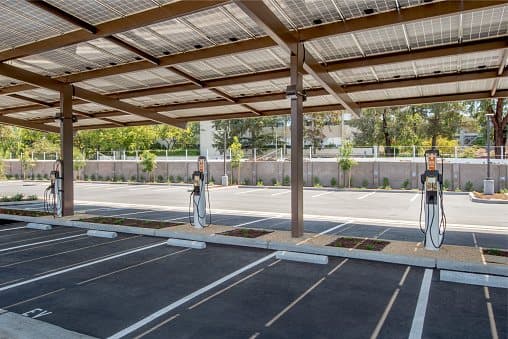
The parking lot is where solar generation and EV demand meet. The canopy produces power during the day; the cars parked beneath it are the most natural load for that power; and the steel structure is a ready-made raceway for the circuits. Designed together, a canopy and its chargers cost less than either does alone and qualify for more incentives. Designed separately, they fight over the same conduit routes and the same service capacity.
Level 2 or DC fast
Level 2 chargers deliver roughly 7 to 19 kW per port and suit parking where cars sit for hours: apartments, workplaces, hotels, and retail centers. DC fast chargers deliver 50 to 350 kW and suit places cars stop briefly: fleet depots, dealerships, highway-adjacent retail, and transit. Most canopy projects are Level 2 with load management, with a few DC fast stalls where the use case demands them. Battery-buffered DC fast charging is the option when the site cannot get the utility service a fast charger needs.
Sizing to the service
The constraint on most sites is the electrical service, not the parking. A 100-space garage cannot give 100 cars 48 amps each without a service the utility will take a year to provide. Load management solves most of this: networked chargers share a circuit and throttle so the panel never exceeds its rating, and the canopy's own generation offsets daytime demand. We start every charging design with a service evaluation: what the existing service can carry, what a load study shows is actually used, and what the utility can add and when.
Conduit in the steel
Chargers under a canopy mount at the column line, and the circuits run inside or along the canopy's beams and columns to a panel at the end of the row. That removes most of the trenching across the lot, which is the expensive, disruptive part of a charging project on an existing surface lot. It also means the conduit can be oversized for the full build-out at almost no cost: if the lot will eventually need forty chargers, the raceway for forty is installed with the steel and the first ten chargers hang today.
What CALGreen now requires
The 2025 California Green Building Standards Code, effective for permits submitted on or after January 1, 2026, raised the EV infrastructure requirements for new construction substantially. For new multifamily buildings, every assigned parking space must be EV Ready, meaning a complete circuit terminating in a Level 2 receptacle, and a share of common-use spaces must have Level 2 chargers installed. For new nonresidential buildings the code sets percentages of total spaces that must be EV Ready and that must have chargers installed, with the installed-charger share in the range of a quarter of spaces for many occupancies, and hotels and motels have their own dedicated requirements. Local reach codes in many Southern California cities go further.
Who pays for the chargers
- LADWP's Commercial EV Charger Rebate Program pays rebates for Level 2 and DC fast chargers at multifamily, workplace, public, and commercial parking in the LADWP service territory: in its most recent round, up to $5,000 per Level 2 charger and up to $125,000 per DC fast charger in disadvantaged communities. It opens in enrollment windows, with the next listed for October 2026, and it continues separately from the federal charging credit (Section 30C), which ended for property placed in service after June 30, 2026.
- The California Energy Commission's CALeVIP programs fund DC fast charging and some Level 2 at publicly accessible sites such as hotels, mixed-use developments, and multifamily properties, by region and funding round.
- Investor-owned utilities run make-ready programs that pay for the electrical infrastructure from the transformer to the parking space, leaving the owner to buy the chargers.
- The canopy's own incentive, the federal investment tax credit, applies to the solar and its structure, so the two halves of the project draw on different funding.
Design sequence
- 01Service evaluation and load study.
- 02Charger count and type by use case, with a build-out target for the raceway.
- 03Canopy layout with chargers located at the column line and the panel at the row end.
- 04Rebate applications filed before equipment is ordered, since most programs require pre-approval.
- 05Permits for structure and electrical in parallel, utility interconnection for the solar and any service upgrade.
- 06Erection, module installation, charger mounting, commissioning, and network activation.
Questions
- Can the canopy's solar power the chargers directly?
- The canopy feeds the building's service, and the chargers draw from the same service, so the solar offsets charging load in the daytime. Direct DC coupling with storage is possible on fleet and fast-charging sites and is designed case by case.
- How many chargers can a 100-space canopy support?
- The structure can carry a charger at every column. The limit is the electrical service; with load management a 400-amp service can typically support several dozen Level 2 ports sharing capacity.
- Do apartment owners have to install chargers now?
- For new construction under the 2025 CALGreen code, yes: assigned spaces must be EV Ready and a share of common spaces must have chargers. Existing buildings are not required to retrofit, but utility rebates make it attractive.
Sources
- California Building Standards Commission: CALGreen (Title 24, Part 11)
- LADWP: Commercial EV Charger Rebate Program
- California Electric Vehicle Infrastructure Project (CALeVIP)
- Southern California Edison: Charge Ready program
Checked against these sources on the date shown above. Codes, incentives, and program terms change; confirm before relying on them.