
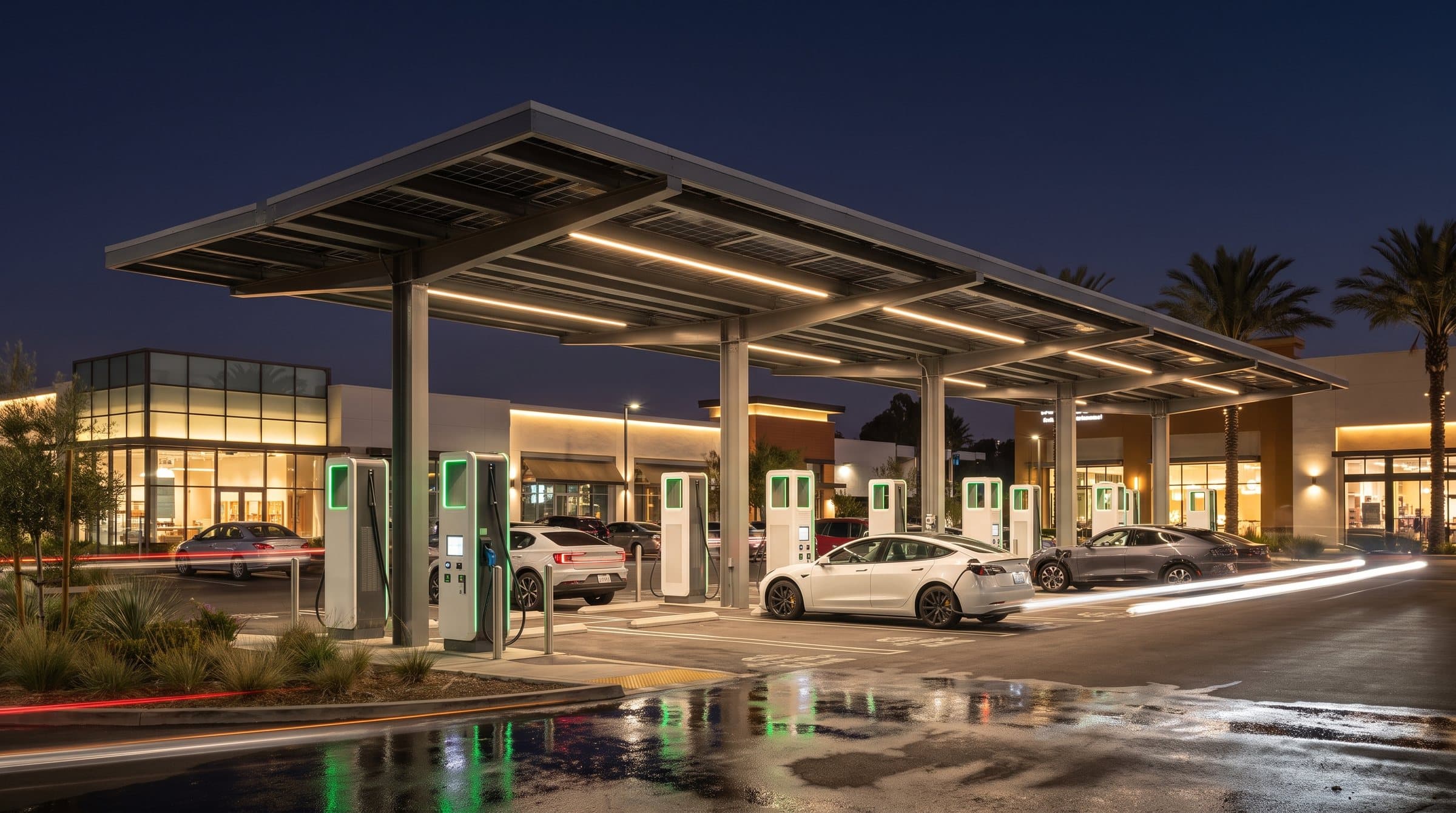
02EV charging
Charging that pays for itself, under a canopy or on its own.
Level 2 and DC fast charging for multifamily, workplace, retail, dealership, and fleet parking, with the electrical design, utility coordination, and rebate paperwork handled by one team.
What we deliver
The chargers, the electrical, the utility, and the rebate paperwork.
Level 2 for where cars sit for hours
Multifamily garages, workplaces, hotels, and retail centers. Networked, OCPP-compliant Level 2 units with load management so a 100-space garage can charge dozens of cars without a service upgrade.
DC fast charging for where they do not
Fleet depots, dealerships, highway-adjacent retail, and transit. Battery-buffered DC fast charging options reduce demand charges and allow high-power charging on constrained service.
Designed with the canopy, or without it
Under a GreenSource solar canopy, conduit runs inside the steel and chargers mount at the column line. On an existing lot, we trench, bore, or surface-mount to suit the paving.
Rebates and incentives
LADWP's Commercial EV Charger Rebate Program, the California Energy Commission's CALeVIP programs, and utility make-ready programs across the state. We prepare the applications as part of the project.
Which charger where
Match the charger to how long the cars stay.
Dwell time decides the charger. Level 2 serves parking where cars sit for hours at a fraction of the cost and service size; DC fast charging is for stops under an hour.
| Property | How long cars stay | Usual charger | What matters |
|---|---|---|---|
| Apartments and condominiums | Overnight | Level 2, 7 to 11 kW per port | Load management shares one service across many spaces; residents are billed through the network |
| Workplaces and campuses | 4 to 9 hours | Level 2 | Sized for daytime dwell; a canopy's solar offsets the charging load |
| Hotels and destinations | Several hours to overnight | Level 2, with some DC fast | Guest amenity, listed in charging apps |
| Retail and restaurants | 30 minutes to 2 hours | DC fast or high-power Level 2 | Dwell time and revenue; public chargers must meet California billing rules |
| Dealerships | Hours for inventory, under an hour in service | Level 2 for inventory, DC fast for service and delivery | J3400 and CCS1 connectors for the brands on the lot |
| Fleets and depots | Overnight or between shifts | Level 2 or DC fast, by duty cycle | Battery-buffered DC fast where the utility service is constrained |
Hardware
A charging hardware line built in Commerce, California.
Our charging hardware partner, Evian Charge, manufactures OCPP-compliant charging equipment a few miles from our canopy fabricator. Specifying from one line keeps commissioning, parts, and service simple, and every unit is open-protocol, so the owner is never locked to one network.
AC Level 2 chargers
Networked, OCPP-compliant Level 2 units for multifamily, workplace, hotel, and retail parking, wall, pedestal, or canopy-column mounted, with load management across a shared circuit.
DC fast chargers
The Iconic and EV 480 DC fast-charging platforms for fleets, dealerships, corridor retail, and transit, in dual-cable configurations that serve J3400 and CCS1 vehicles natively.
Battery-buffered fast charging
The BABA battery-integrated DC fast charger delivers high power on a constrained utility service and trims demand charges by charging its battery off-peak.
Vehicle-to-grid and storage
V2G-capable units and the EVian-D48 containerized battery system (5 MWh class) for fleet depots, resilience, and off-grid charging sites.
Fleet and transit
Bus pantograph and portable charging solutions for depots and yards.
Approvals
CTEP and NTEP approvals for measurement and billing accuracy on publicly available chargers, as California requires.
Model-level data sheets are available on request. Rebate eligibility is confirmed against each program's equipment list before anything is ordered.
How a charging project runs
Six steps from a load study to a live network.
01
Site walk and load study
We document the service, the panels, and the parking, and measure or calculate the existing load to find the capacity available for charging.
02
Layout and equipment
Charger count, type, and locations by use case, with conduit sized for the build-out you expect rather than for day one only.
03
Rebates first
Where a program requires pre-approval or a reservation, it is filed before equipment is ordered, and the hardware is checked against the program's eligible list.
04
Permits and utility
Electrical permit, accessible-stall design, and any service upgrade application with the utility, run in parallel.
05
Installation
Trenching or surface raceway, panels, mounting, and wiring, phased so the lot stays open.
06
Commissioning and handover
Network activation, pricing and access settings, driver signage, rebate claim paperwork, and a service plan.
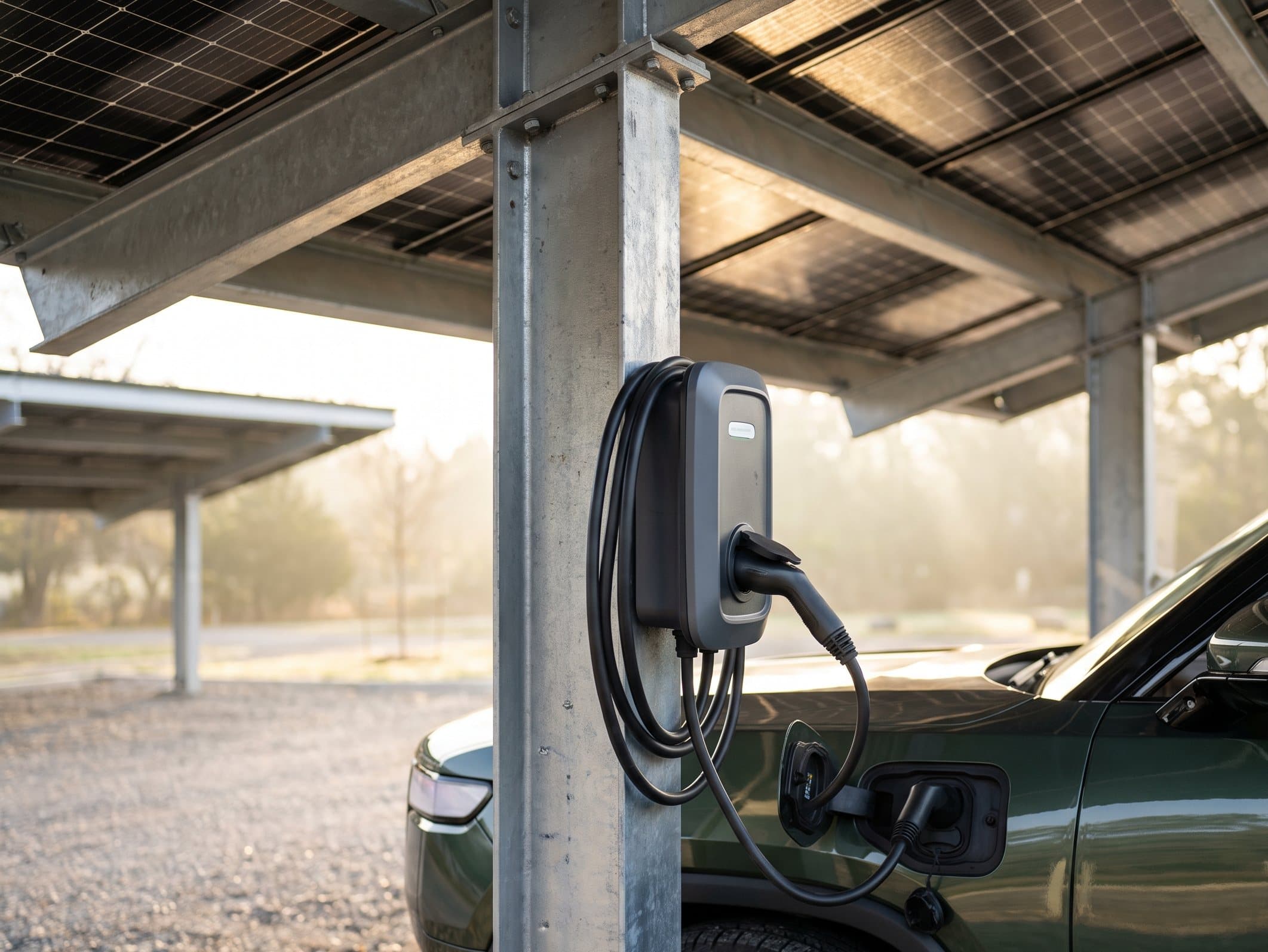
Canopy plus charging
The array above pays for the chargers below.
A solar canopy with EV charging stacks the Title 24 solar requirement, the federal solar credit, and the utility's charger rebate on one footprint, and it keeps the conduit inside the steel instead of in a trench across the lot.
Questions
What owners ask before they add chargers.
More in the guides: EV charging under a solar canopy, NACS and J3400, and Wall Connectors at apartments.
Do we need a service upgrade to add EV chargers?
Often not. California's Electrical Code (Section 625.42) lets an automatic load management system cap the combined charger load, so the service and feeders are sized to the managed maximum rather than to every charger at full power. A load study shows how much capacity you have before anything is designed.
Level 2 or DC fast charging?
Match the charger to how long cars stay. Where vehicles park for hours, Level 2 at 7 to 19 kW per port does the job at a fraction of the cost and service size. DC fast charging at 50 kW and up is for stops under an hour: retail, corridors, fleets between shifts, and dealership service lanes.
Can we charge drivers for using the chargers?
Yes. Networked, OCPP-compliant chargers let the owner price by the kilowatt-hour, by the hour, or by session, or offer charging free. In California, publicly available chargers that bill by the kilowatt-hour must use equipment approved for measurement accuracy under the state's CTEP program.
Which connector should we specify?
For Level 2, J1772 and J3400 both work: Teslas ship with a J1772 adapter, and many new EVs use J3400. For DC fast charging in 2026, specify dual-cable posts with J3400 and CCS1 so every vehicle charges without an adapter.
What rebates are available in Los Angeles?
LADWP's Commercial EV Charger Rebate Program has paid up to $5,000 per Level 2 charger and up to $125,000 per DC fast charger, in enrollment windows; LADWP lists the next one for October 2026. Outside LADWP territory, utility make-ready programs and the California Energy Commission's CALeVIP fund chargers when their rounds are open. We check eligibility before equipment is specified.
Do EV charging spaces have to be accessible?
Yes. The California Building Code requires a share of EV charging spaces to be accessible, with set space and access-aisle dimensions and reach ranges (Sections 11B-228.3 and 11B-812). We lay out the accessible spaces from the first drawing.
How long does an installation take?
On an existing service with no upgrade, a Level 2 project typically needs a few weeks of construction once the permit is issued. A service upgrade or a new transformer puts the utility on the critical path, often for months, so that application goes in first.