
Tesla Wall Connectors at apartments and workplaces
Tesla's Wall Connector is a Level 2 charger that delivers up to 11.5 kW and can share a circuit among several units. How a multifamily or workplace installation is designed, how billing works for commercial hosts, what the 2025 CALGreen code requires, and where utility rebates apply.
6 min read · Updated October 6, 2026
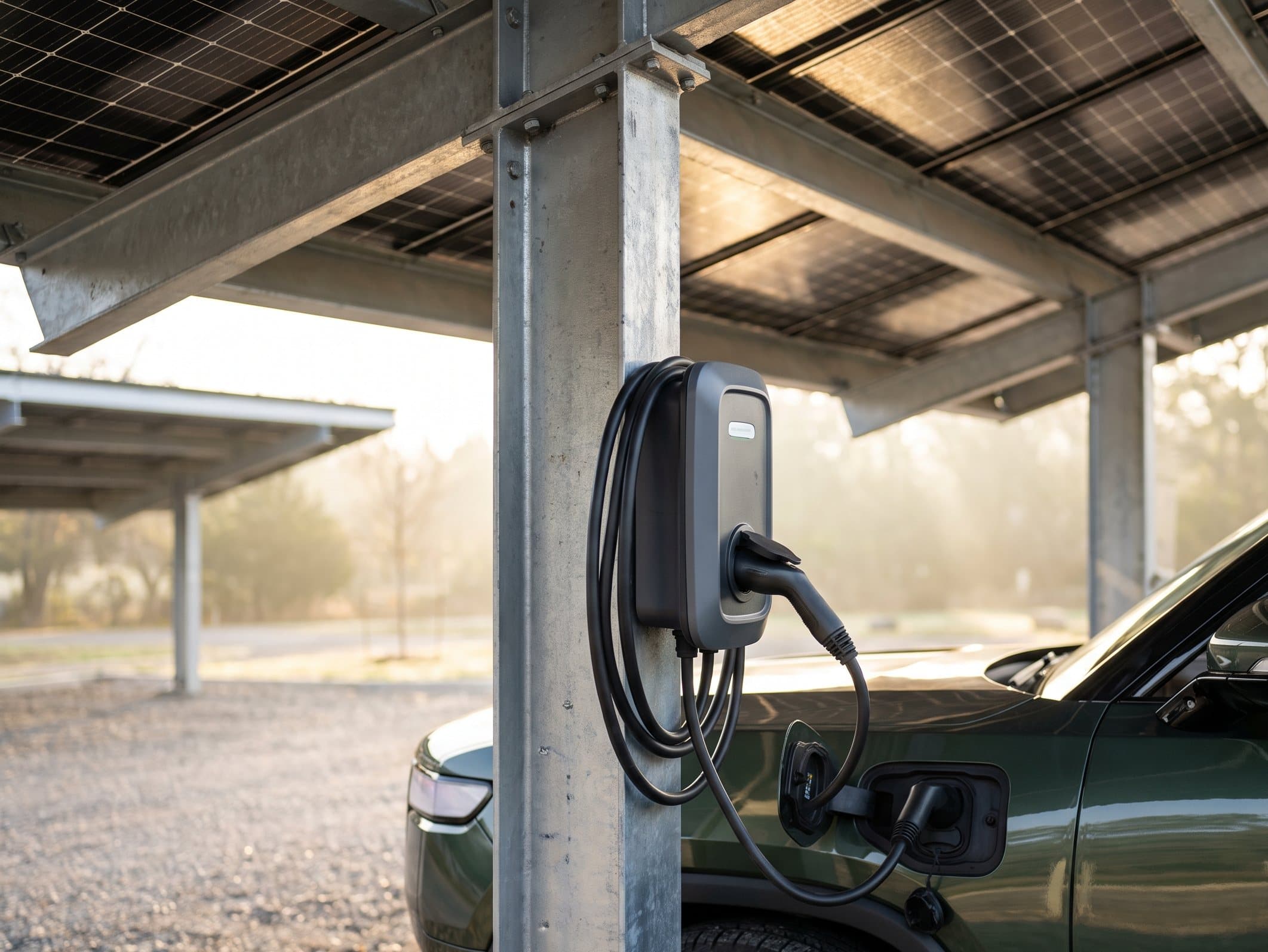
Residents and employees who drive Teslas ask for one thing from a building: a place to plug in overnight or during the day. Tesla's Wall Connector is the hardware they recognize, and for many hosts it is the simplest way to say yes. A commercial installation of Wall Connectors is still an electrical project with load calculations, permits, and code requirements, and it is worth understanding before you commit to a count.
The hardware
The Wall Connector is a Level 2 charger that delivers up to 48 amps, about 11.5 kW, on a 60-amp circuit, with Wi-Fi connectivity for monitoring and updates. It supports power sharing, under which several Wall Connectors on a single circuit coordinate so their combined draw never exceeds the circuit's capacity, which is how a building adds charging without adding service. The Universal Wall Connector adds a built-in J1772 adapter so non-Tesla vehicles charge from the same unit. Tesla also offers commercial charging features that let a host bill drivers for sessions; availability and terms are Tesla's and change, so confirm the current commercial offering before relying on it.
Designing the installation
- 01Load study. A licensed electrician or engineer measures the building's actual demand, which is usually far below the service rating, to find how much capacity exists for charging under the electrical code's load calculation rules.
- 02Charger count and sharing groups. Power sharing lets, for example, six Wall Connectors share a circuit; the design sets how many groups the available capacity supports and what each driver will see at a busy hour.
- 03Panel and feeder. A dedicated subpanel near the parking area, fed from the house service or a new service, with branch circuits to each sharing group.
- 04Raceway. Surface conduit in a garage, trenching on a surface lot, or conduit inside the steel of a solar canopy, which is the least disruptive path on an open lot.
- 05Mounting. Wall-mounted in garages, pedestal-mounted on surface lots, or column-mounted under a canopy.
- 06Permit and inspection. An electrical permit with the city, and an energy-management-system note on the drawings when power sharing is used to justify the load calculation.
What the code requires
For new multifamily buildings permitted from January 1, 2026, the 2025 CALGreen code requires every assigned parking space to be EV Ready, meaning a complete circuit terminating in a receptacle or charger, and a share of common spaces to have Level 2 chargers installed. For new nonresidential buildings the code requires percentages of total spaces to be EV Ready and to have chargers installed. Wall Connectors installed at those spaces satisfy the installed-charger requirement when the circuit and the energy management system meet the code's definitions. Existing buildings are not required to retrofit, but California law limits an HOA's or landlord's ability to refuse a resident's reasonable request to install charging at their space, which is a strong reason to plan a building-wide installation rather than respond to requests one at a time.
Rebates
Utility rebates for Level 2 charging at multifamily and workplace parking are generous in Southern California, with LADWP's commercial program paying up to $5,000 per Level 2 charger in its most recent round and a new enrollment window listed for October 2026. Most programs require networked chargers from an eligible-equipment list and pre-approval before purchase. Whether a given Wall Connector model is on a program's list changes with program rounds; where it is not, a networked unit from another manufacturer with a J3400 or J1772 connector serves Teslas equally well and keeps the rebate. We check eligibility before equipment is specified.
Workplaces
Workplace charging has a daytime profile that matches solar production, so a canopy over employee parking and Wall Connectors at its columns is a natural pairing: the array covers the charging load, the chargers give employees eight hours of Level 2, and power sharing keeps the service small. Employers often make charging free as a benefit and recover the cost through the canopy's offset of the building's bill.
Questions
- How many Wall Connectors can share one circuit?
- Tesla's power sharing supports several units on a single circuit, coordinating so the combined draw stays within the circuit's rating. The design sets the group size from the available capacity and the charging experience the host wants.
- Can non-Tesla cars use a Wall Connector?
- Yes, with the Universal Wall Connector, which includes a built-in J1772 adapter, or with a driver's own adapter on the standard unit.
- Do I need a service upgrade?
- Often not. A load study usually finds unused capacity, and power sharing keeps the charging load inside it. Large installations or buildings already near capacity may need an upgrade, which the utility delivers on its own timeline.
Sources
- California Building Standards Commission: CALGreen (Title 24, Part 11)
- LADWP: Commercial EV Charger Rebate Program
Checked against these sources on the date shown above. Codes, incentives, and program terms change; confirm before relying on them.