
Tesla charging stations for your business: the four ways in
A property owner has four routes to Tesla charging: host a Tesla-owned Supercharger site, buy your own Superchargers through Tesla's Supercharger for Business program, join Destination Charging with Wall Connectors for guests, or install your own chargers with the NACS (SAE J3400) connector. What each requires, who pays, and where the engineering comes in.
8 min read · Updated October 6, 2026
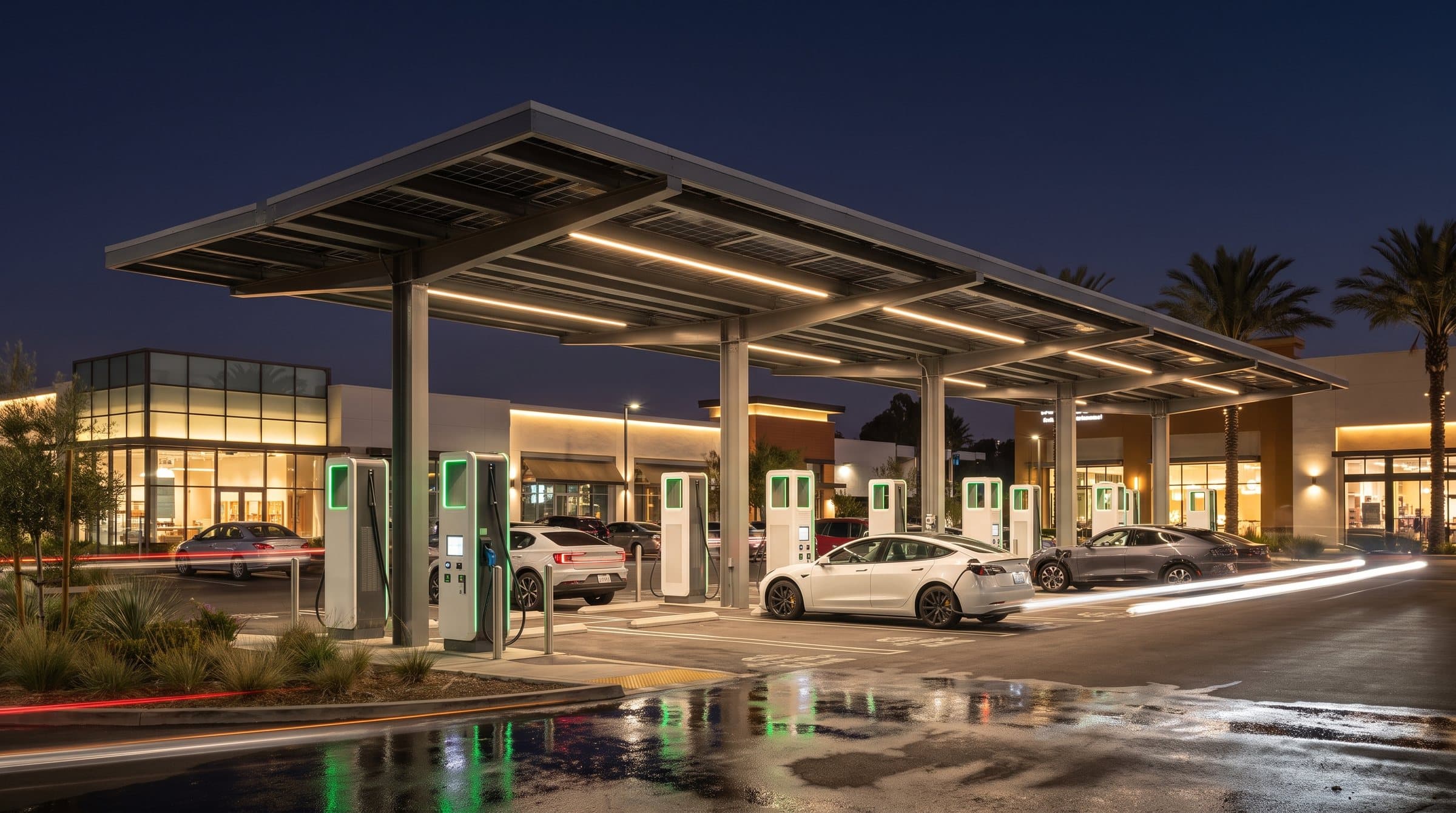
Tesla drivers are the largest single group of EV drivers in California, and with most automakers now shipping vehicles with Tesla's connector, the Tesla charging experience is becoming the default for everyone. For a property owner, hotel, retailer, developer, or fleet, "I want Tesla charging" can mean four different projects with very different economics. This guide separates them and explains where GreenSource fits: we engineer, permit, and build the site infrastructure, including the solar canopy when there is one, for all four.
Route 1: host a Supercharger site
Tesla's Supercharger network is owned and operated by Tesla. Property owners become site hosts: they provide the parking stalls and access under a long-term agreement, and Tesla typically funds, installs, owns, operates, and maintains the charging equipment, including the utility coordination for the large service a fast-charging site needs. The host's return is foot traffic and dwell time, a lease or license payment in some cases, and a destination that appears in every Tesla's navigation. Tesla selects sites against its own network plan, so hosting is an application, not a purchase. Our article on becoming a Supercharger site host covers what Tesla looks for and what the host side of the engineering involves.
Route 2: buy your own Superchargers (Supercharger for Business)
Since September 2025, Tesla also sells Superchargers to businesses. Under its Supercharger for Business program, the owner buys white-labeled Supercharger posts, with a minimum order of four posts per Tesla's program page, hires its own installer to build the site, sets its own prices, and keeps the charging revenue. Tesla runs network operations, preventive maintenance, and driver support, and the site appears in Tesla's in-car map and Trip Planner. Tesla describes the posts as compatible with all EVs. This is the route for a property that wants fast charging on its own schedule rather than waiting for Tesla to select it as a host, and it puts the whole site build on the owner's side: utility service, switchgear, cabinet and post foundations, conduit, accessible stalls, and lighting. Our Supercharger for Business guide walks through it.
Route 3: Destination Charging with Wall Connectors
Destination Charging is Tesla's program for places where drivers stay for hours: hotels, restaurants, resorts, wineries, retail centers, and parking operators. Hosts install Tesla Wall Connectors, Level 2 units that deliver up to 11.5 kW, and the location is listed in Tesla's in-car navigation and app. The host pays for installation and typically for electricity, and Tesla has at various times supplied Wall Connectors to qualifying hosts at reduced or no cost; the program's terms change, so confirm the current offer with Tesla. For the host this is a conventional Level 2 charging project with Tesla hardware and a listing benefit, and it is where most hospitality and multifamily owners land.
Route 4: your own chargers with the NACS connector
Since Tesla opened its connector as the North American Charging Standard and SAE standardized it as J3400, charging hardware from many manufacturers ships with J3400 cables. A property can install its own networked Level 2 or DC fast chargers, bill drivers on its own terms, and serve Teslas natively alongside every other EV with a J3400 port or an adapter. This route gives the owner the most control over revenue, branding, and software, and it is the route that pairs most naturally with a solar canopy and with utility rebates, which generally require listed, networked equipment from an eligible-products list rather than a specific brand.
Side by side
| Supercharger host | Supercharger for Business | Destination Charging | Own NACS chargers | |
|---|---|---|---|---|
| Who owns the equipment | Tesla | Owner | Host | Host |
| Who pays for installation | Tesla, typically | Owner, with its own installer | Host | Host (rebates often apply) |
| Charging speed | DC fast, 250 kW and up | DC fast, V4 posts up to 500 kW | Level 2, up to 11.5 kW | Level 2 or DC fast, your choice |
| Who sets pricing | Tesla | Owner | Host (free or billed) | Host |
| Who operates and services | Tesla | Tesla, on the owner's behalf | Host | Host and its network |
| Listing | Tesla navigation and app | Tesla navigation and Trip Planner | Tesla navigation and app | Your network's app and open maps |
| Best for | Corridor and high-traffic retail sites Tesla selects | Retail, travel, hospitality, and fleets that want branded fast charging now | Hotels, restaurants, retail, parking operators | Multifamily, workplaces, fleets, dealerships, anyone wanting control |
| Pairs with a solar canopy | Sometimes | Yes | Yes | Yes |
Where the engineering comes in
All four routes end in the same physical work: a utility service sized for the load, switchgear and panels, trenching or a canopy raceway to the stalls, ADA-compliant charging spaces, lighting, and permits with the city. For a Supercharger site the host often has to prepare the site, resolve easements, and coordinate the civil work. For Supercharger for Business, Destination Charging, and owner-installed chargers the owner carries the whole site project. GreenSource provides the electrical and civil engineering through our charging-station engineering partner, builds the site as a licensed California contractor, and designs the solar canopy over the stalls when the owner wants shade and generation on the same footprint.
Which route for which property
- Retail center or travel plaza on a major corridor with room for a transformer and eight or more stalls: apply to host a Supercharger, and plan owner-installed Level 2 for the rest of the lot.
- Retail, travel, or hospitality site that wants branded fast charging and the revenue from it, without waiting on Tesla's site selection: buy at least four posts through Supercharger for Business and build the site with your own installer.
- Hotel, resort, or restaurant: Destination Charging for guest convenience, often with a few owner-installed fast chargers if the location sees pass-through traffic.
- Apartment or condominium: owner-installed networked Level 2 with J3400 or J1772 connectors, billed to residents, under a canopy where there is surface parking.
- Workplace or campus: owner-installed Level 2 with load management, sized for daytime dwell.
- Dealership or fleet: owner-installed with a mix of Level 2 and DC fast, J3400 where the vehicles use it.
Questions
- Can any business get a Tesla Supercharger?
- To host a Tesla-owned site, no: Tesla selects host sites against its network plan. Since September 2025, though, any business can buy Superchargers through Tesla's Supercharger for Business program, with a minimum order of four posts, and hire its own installer. Destination Charging and owner-installed NACS chargers are also available to any property.
- Do I need Tesla hardware to charge Teslas?
- No. Any charger with a J3400 (NACS) connector charges a Tesla natively, and Teslas can use J1772 Level 2 chargers with the adapter every Tesla ships with. Many owners choose non-Tesla networked hardware for billing flexibility and rebate eligibility.
- Can GreenSource apply to Tesla for me?
- The site host application is made by the property owner. We prepare the site information Tesla asks for, including utility capacity, stall layout, and access, and we handle the engineering and construction on the host's side of the project.
Sources
- Tesla: Supercharger for Business
- Tesla: Host a Supercharger
- Tesla: Destination Charging
- SAE J3400 North American Charging System (NACS)
Checked against these sources on the date shown above. Codes, incentives, and program terms change; confirm before relying on them.