
How to host a Tesla Supercharger site
Tesla owns and operates Superchargers; property owners host them. What makes a site attractive to Tesla, what the host agreement typically covers, how much utility capacity a fast-charging site needs, and the civil and electrical work a host should expect on its side of the line.
7 min read · Updated October 6, 2026
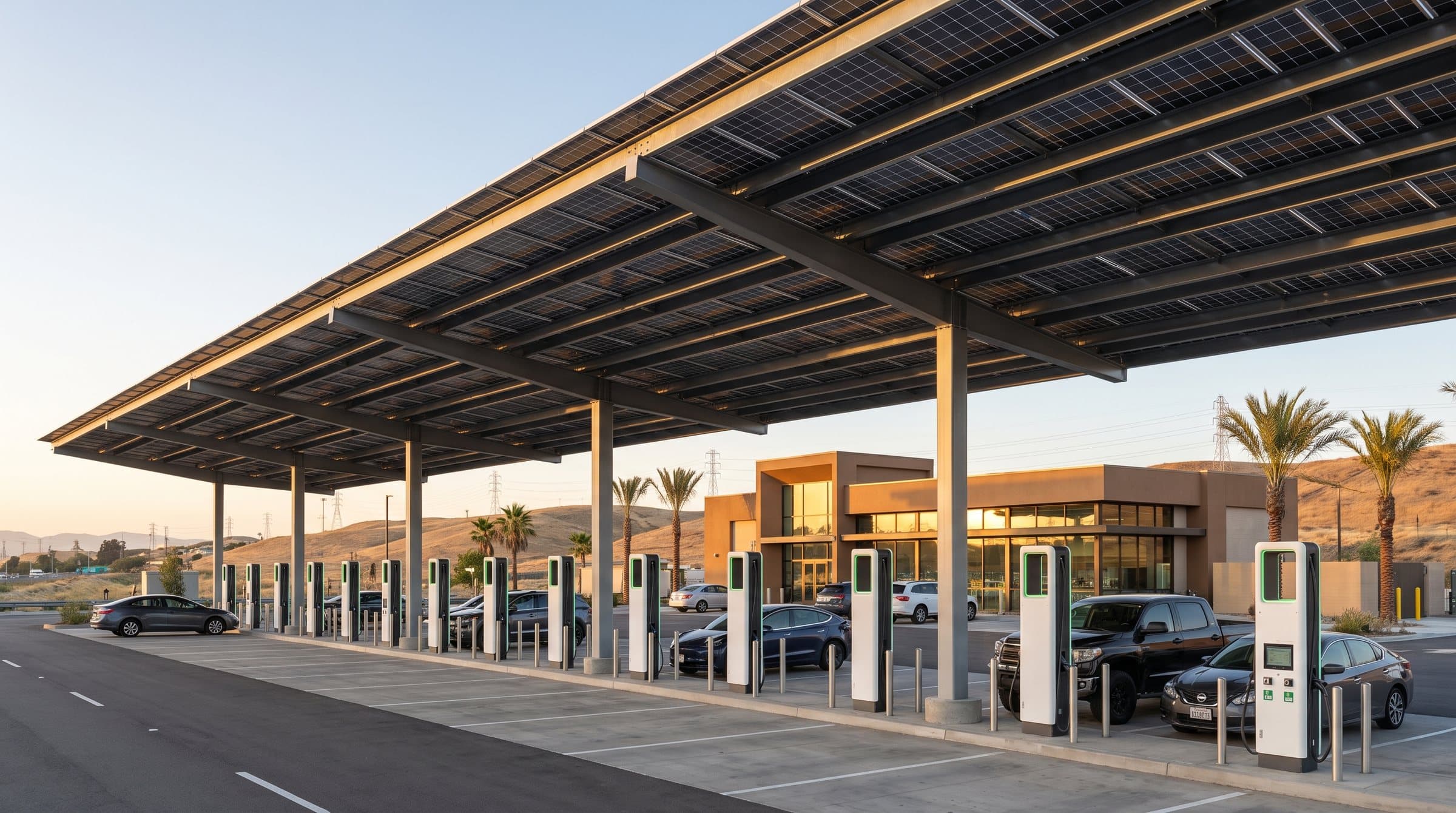
A Supercharger site is one of the few amenities that reliably brings drivers to a property for twenty to forty minutes, several times a day, every day. Retailers, restaurant operators, travel centers, and shopping-center owners pursue them for the dwell time alone. The catch is that Tesla, not the host, decides where Superchargers go, and Tesla's criteria are specific. Here is how the process generally works and what a host should prepare for. If you would rather own the chargers, set the price, and skip site selection, Tesla's Supercharger for Business program sells Superchargers to businesses; our separate guide covers that route.
What Tesla looks for
- Location on or near a major travel corridor, or in a dense urban area with limited home charging.
- Twenty-four-hour, seven-day public access to the stalls, without gates or validation.
- Amenities within walking distance: food, restrooms, retail, and lighting.
- Room for a bank of stalls, commonly eight to sixteen or more, laid out so cables reach the charge port on any vehicle, plus space for the Supercharger cabinets, switchgear, and a utility transformer.
- Utility capacity. A Supercharger site with eight to sixteen stalls commonly needs a new service in the range of one to three megawatts, which means a utility transformer on site and often utility-side upgrades. Sites where that service can be delivered within a reasonable time move faster.
- A cooperative owner willing to grant the easements and a long-term agreement the installation needs.
What the agreement typically covers
Supercharger hosting is structured as a lease or license of the parking stalls and equipment areas for a term of years, with Tesla funding, owning, operating, and maintaining the equipment and handling the utility account for the chargers. Terms vary by site and by Tesla's current program; some hosts receive rent, others host for the traffic. Hosts should expect provisions on access, signage, maintenance of the surrounding lot, and easements for utility infrastructure. Review the agreement with counsel; the long term and the utility easements affect the property for decades.
The host's side of the engineering
Tesla or its contractors install the Supercharger equipment, but the site has to be ready for it, and the division of responsibility is negotiated. The host side often includes some or all of the following:
- A site plan that relocates stalls, adjusts drive aisles, and preserves fire access and ADA parking counts after the Supercharger stalls are carved out.
- Civil work: demolition, trenching, conduit, concrete pads for the transformer and cabinets, bollards, curbs, and repaving.
- Electrical coordination with the utility for the new service, including the transformer location and the primary feed route across the property.
- Site lighting to the levels the agreement and the city require.
- Accessible charging spaces designed to the California Building Code's EV charging accessibility requirements.
- A solar canopy over the stalls, if the host wants shade, generation, and a visible structure; the canopy is the host's project and is designed around Tesla's equipment and cable reach.
- Permits with the city for everything on the host's side.
Timeline
The long pole on a Supercharger site is almost always the utility service. New multi-megawatt services in Southern California commonly take twelve to eighteen months or more from application to energization, and some take longer when a substation or primary line upgrade is involved. Tesla's internal selection and design add their own months. Hosts that have already had a utility capacity conversation, or that have a service upgrade in progress for another reason, are more attractive because they shorten that path.
Preparing an application
- 01Confirm the property's utility: LADWP, Southern California Edison, or another, and request a preliminary capacity conversation.
- 02Prepare a parcel map and a parking plan showing where eight to sixteen stalls plus equipment could go without losing required parking.
- 03Document access, hours, and amenities.
- 04Submit through Tesla's site host program and expect Tesla's real estate team to evaluate the site against its network plan.
- 05In parallel, decide what else the lot needs: owner-installed Level 2 for the rest of the parking, a canopy, lighting upgrades. Doing the civil work once is far cheaper than twice.
GreenSource prepares the site information, designs the host-side civil and electrical work, builds it as the licensed contractor, and designs the canopy when the host wants one. We do not represent Tesla and cannot influence its site selection; what we can do is make a site ready and make the host's half of the project run on one schedule.
Questions
- Does Tesla pay rent to Supercharger hosts?
- Terms vary by site and program. Some hosts receive lease payments; many host primarily for the traffic and dwell time. Tesla's current program terms govern.
- How many parking spaces does a Supercharger site take?
- Commonly eight to sixteen stalls plus the equipment area for cabinets, switchgear, and a transformer. Larger corridor sites run to dozens of stalls.
- Can a Supercharger site have a solar canopy?
- Yes. The canopy is the host's structure and is designed around the charging equipment and cable reach. Several Supercharger sites have canopies; the host usually owns the canopy and its solar production.
- What if Tesla does not select my site?
- Tesla's Supercharger for Business program, launched in September 2025, lets a business buy Superchargers outright, with a minimum order of four posts, hire its own installer, and have Tesla operate and service them. It does not depend on Tesla's host site selection.
Sources
Checked against these sources on the date shown above. Codes, incentives, and program terms change; confirm before relying on them.