
Solar carports for multifamily properties
Why apartment and condominium owners in California are putting solar canopies over resident parking: common-area energy, tenant EV charging, CALGreen compliance for new buildings, the 2026 incentives, and how the project runs on an occupied property.
6 min read · Updated October 6, 2026
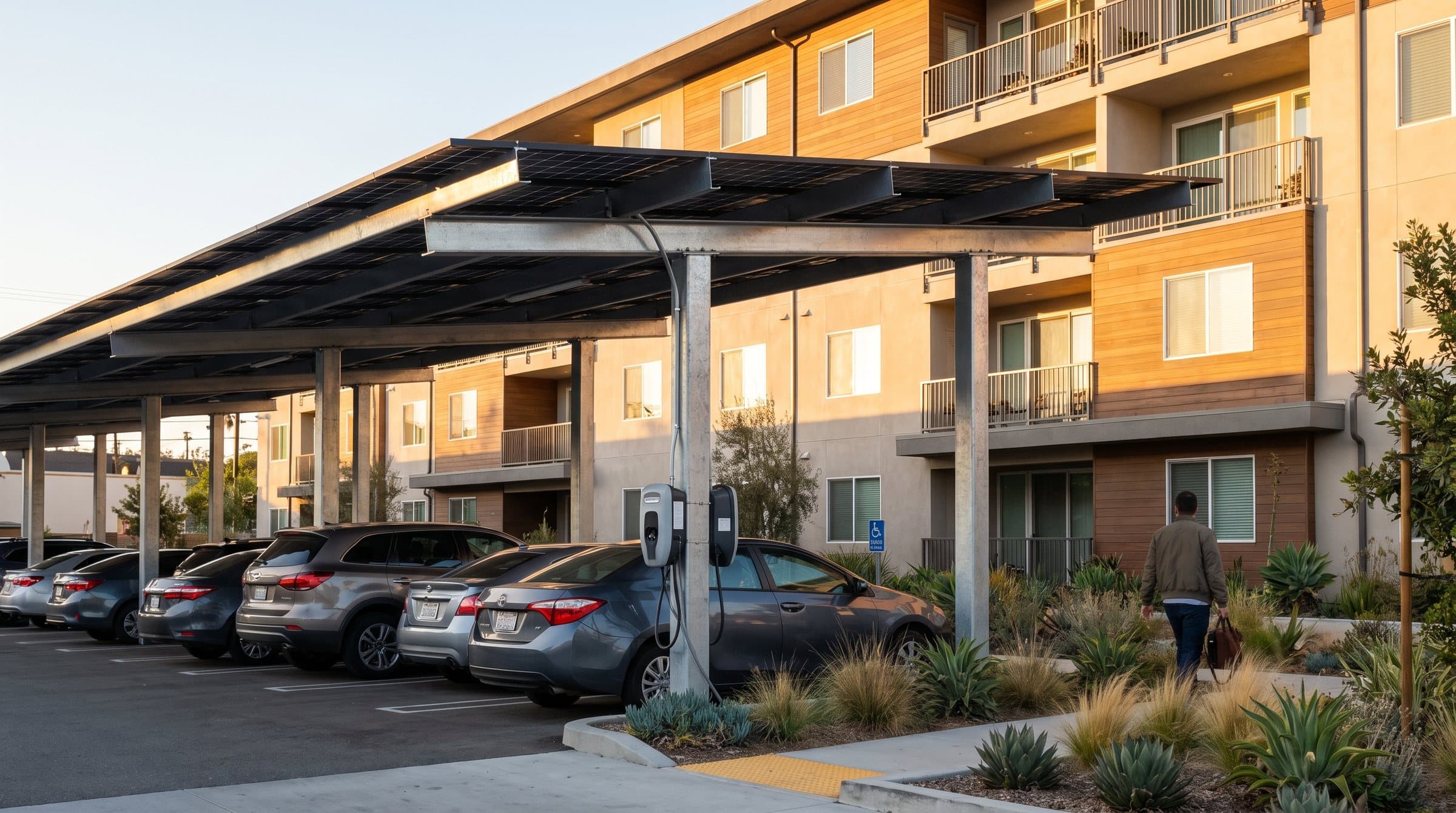
Multifamily parking is the most under-used asset on a residential property: a large, flat, sunny area that produces nothing and that residents increasingly want to charge a car in. A solar canopy turns it into generation, shade, and EV-ready parking in one project, and it does so on a property type that California's incentive laws explicitly name.
What the owner gets
- Common-area energy. The canopy offsets house meters: corridor and site lighting, elevators, pool equipment, laundry, and common HVAC. On many properties the common load is large enough to absorb a canopy's full output.
- Tenant EV charging as an amenity or a revenue line. Networked Level 2 chargers at the columns bill residents by the kWh, and the canopy's daytime generation offsets the load.
- Protected parking. Shade lowers cabin temperatures and protects paint and interiors, which residents notice and which supports rent.
- A sustainability story that leasing can use and that lenders increasingly ask about.
New construction: the code now requires most of it
For new multifamily buildings, two 2025 codes converge on the parking lot. Title 24 requires a PV system on buildings of three or more stories, and the roof of a carport counts toward the area that sizes it. CALGreen requires every assigned parking space to be EV Ready and a share of common spaces to have chargers installed. A canopy carries the required PV, runs the required EV circuits in its steel, and does both on a surface that would otherwise be a parking lot. Developers who design the canopy into the site plan avoid paying twice for conduit and once more for a roof system that does not fit.
Existing properties: voluntary, and well supported
On an existing property there is no code mandate, but the incentives are real. The federal investment tax credit applies to the solar, with the December 31, 2027 placed-in-service deadline for projects that started construction after July 4, 2026. LADWP and other utilities pay rebates for Level 2 chargers at multifamily common-area parking when their enrollment windows are open. Owners often find the rebates cover much of the charger cost and the canopy is paid for by common-area savings and the federal credit.
Running the project on an occupied property
The practical questions on an occupied property are where residents park during construction and how long each row is out of service. A bolted canopy system helps: foundations for a row are drilled and poured in a few days, the steel for a row goes up in a day or two, and modules follow. We phase rows so that only one row is closed at a time, schedule drilling for working hours, and coordinate with property management on notices and temporary parking. Conduit runs in the steel rather than in trenches, so there are no open cuts across the lot for weeks.
Condominiums and HOAs
For HOAs the canopy is a common-area improvement that typically requires a board vote and, depending on the CC&Rs, a membership vote above a cost threshold. California law also limits an HOA's ability to refuse an owner's request to install EV charging at their assigned space, which makes a planned, association-led canopy and charging program a better outcome than a patchwork of individual installations. We prepare the board package: layout, budget range, incentive summary, and the phasing plan.
Who is a good fit
- Garden-style and podium properties with surface parking of 30 spaces or more.
- Properties with high common-area electric bills: pools, elevators, central systems.
- Properties where residents have asked for EV charging or where leasing competes with newer buildings that have it.
- New developments of three or more stories, where the code requirement is already on the drawings.
Questions
- Can the canopy power individual apartments?
- Through virtual net metering, a multifamily solar system can allocate credits to tenant meters. More commonly the canopy offsets common-area meters and chargers; we model both and recommend based on the property's load and rate structure.
- How much parking is lost during construction?
- One row at a time. A typical row is closed for one to two weeks across foundations, steel, and modules, and we phase rows so most parking stays open.
- Do residents pay for charging?
- That is the owner's choice. Networked chargers can bill residents by the kWh, bundle charging into rent, or offer it free as an amenity.
Sources
- California Energy Commission: 2025 Building Energy Efficiency Standards
- California Building Standards Commission: CALGreen (Title 24, Part 11)
- IRS: Clean Electricity Investment Credit (Section 48E)
- LADWP: Commercial EV Charger Rebate Program
Checked against these sources on the date shown above. Codes, incentives, and program terms change; confirm before relying on them.