
What a solar carport costs in California in 2026
Installed commercial solar carports in California run roughly $2.75 to $3.50 per watt, with the steel structure about half the cost. Here is how that breaks down per parking space, what drives the price up or down, and how the 2026 incentives change the net number.
7 min read · Updated October 6, 2026
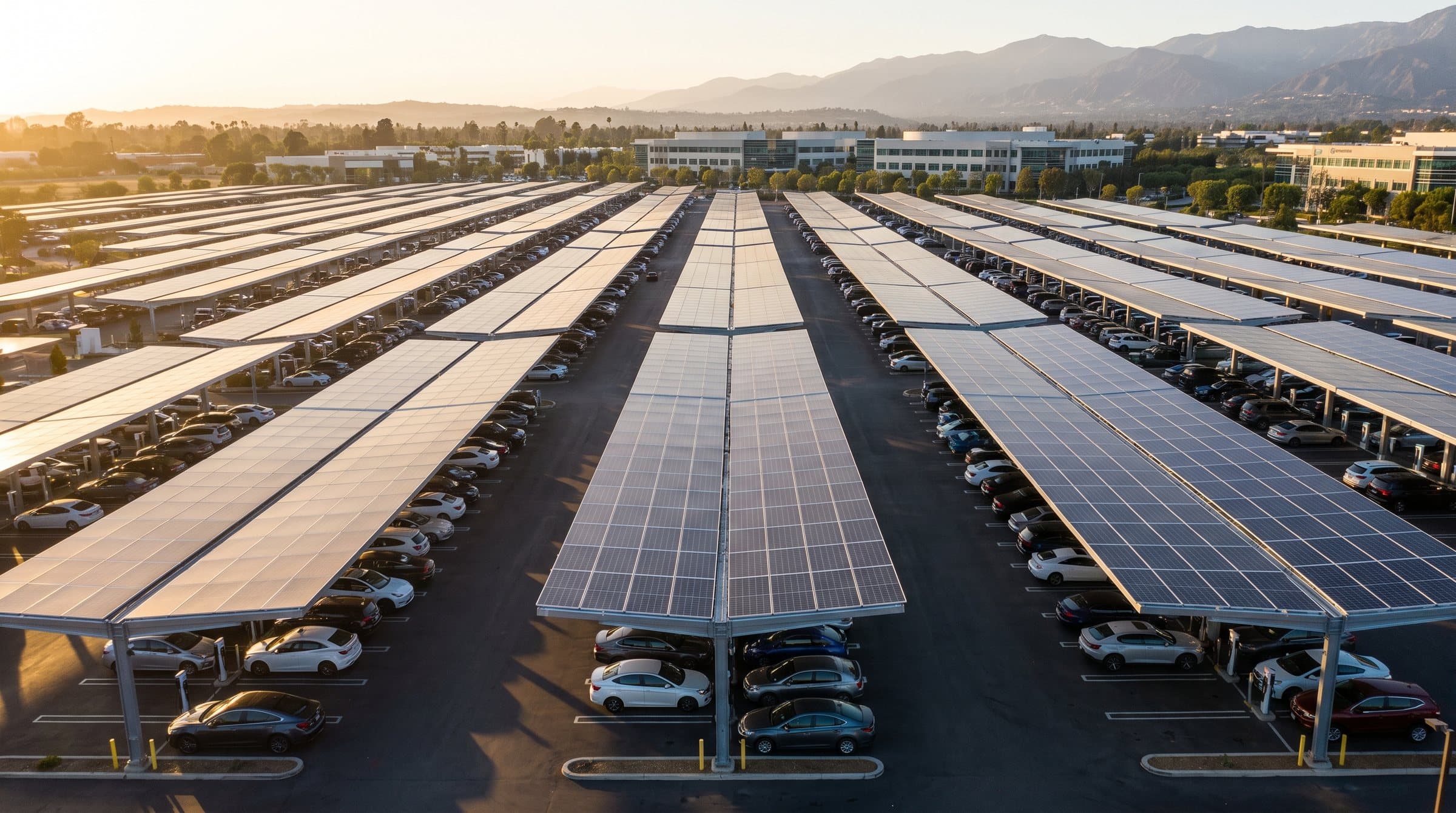
Owners usually ask the cost question two ways: what does it cost per watt, because that is how solar is quoted, and what does it cost per parking space, because that is how a parking lot is budgeted. Both answers are useful and they do not always move together. This guide gives the ranges we see for commercial canopies in Southern California, explains what pushes a project to the top or bottom of the range, and walks through the incentives that apply in 2026.
The headline range
Installed commercial solar carports in California typically land between $2.75 and $3.50 per watt DC for projects of roughly 50 kW and up. A rooftop commercial system in the same market is usually $1.75 to $2.50 per watt, and the difference is the structure: the steel canopy, its foundations, and the labor to erect it account for roughly 40 to 50 percent of a canopy project's cost. Smaller canopies, under about 30 kW, can run above $4.00 per watt because engineering, mobilization, and permitting are spread over fewer modules.
| Scope | Typical range | Notes |
|---|---|---|
| Installed solar carport, 50 kW and up | $2.75 to $3.50 per watt | Structure, foundations, PV, electrical, permits, interconnection |
| Structure only (steel, foundations, erection) | $1,200 to $4,000 per space | Factory-direct pricing; long rows at the low end, short custom runs at the high end |
| Installed cost per space (all-in) | $8,000 to $25,000 per space | National range; depends on kW per space, soils, and wind and seismic design |
| Rooftop commercial solar, for comparison | $1.75 to $2.50 per watt | No structure cost, but limited by roof area, shading, and roof condition |
A worked example
Take a 100-space surface lot laid out in TITAN double-row bays. Each four-space bay carries roughly 5 to 6 kW of modules, so the lot supports about 125 to 150 kW. At $3.00 per watt the installed canopy project is in the range of $375,000 to $450,000 before incentives. The same 100 spaces in single-row LETO bays along a perimeter carry less array per space, about 2.5 to 3 kW per two-space bay, so the kW total is lower and the cost per watt is somewhat higher because there are more columns and footings per module.
What drives the price
- Row length. Engineering, mobilization, and permit fees are fixed; every additional bay in a row spreads them thinner. A 20-bay row costs far less per space than two 5-bay rows.
- Geometry. Double-row T-cantilever bays carry twice the array per column line, so TITAN layouts are the most cost-efficient per watt. Single-row LETO bays are the right answer along perimeters and drive aisles but carry more steel per module.
- Wind and seismic design. Coastal and canyon exposures, higher wind speeds, and site-specific seismic categories add steel. Most California lots fall within standard pre-engineered designs rated to 110 mph.
- Soils and foundations. Caissons are standard; poor soil, shallow utilities, or a parking deck can push a project to spread footings or deck-mounted bases, each with its own cost.
- Finish. Standard G90 galvanizing covers most inland sites. Hot-dip galvanizing or a primed and painted HSS system adds cost but is the right choice within a few miles of the ocean.
- What hangs on the structure. Under-canopy lighting, soft-lit under-sheeting, branding, and EV charging each add cost, and each is cheaper to design in than to retrofit.
- Electrical distance. The run from the canopy to the main service, the size of the existing service, and whether a service upgrade or a new transformer is needed can swing a budget more than the modules do.
Incentives in 2026
Three kinds of incentives apply to a California canopy project this year, and two of them have clocks on them.
- Federal investment tax credit (Section 48E): 30 percent of the eligible system cost. The 2025 federal tax law changed the schedule: a project that began construction by July 4, 2026 keeps the credit as long as it is placed in service within four years; a project that starts later must be placed in service by December 31, 2027. For a canopy that means permits and procurement in 2026 and construction in 2027 at the latest.
- California property tax: under Revenue and Taxation Code section 73, a new active solar energy system is not treated as new construction, so its value is not added to the assessed value of the property. Under current law the exclusion covers solar construction completed before January 1, 2027, unless the Legislature extends it. California does not offer a state income tax credit for solar canopies: the 5 percent canopy credit proposed in SB 49 in 2023 was removed before the bill was enacted.
- Utility EV charger rebates: in its most recent round, LADWP's Commercial EV Charger Rebate Program paid up to $5,000 per Level 2 charger and up to $125,000 per DC fast charger in disadvantaged communities ($4,000 and $100,000 elsewhere), at up to 80 Level 2 chargers per site. The program opens in enrollment windows; LADWP lists the next one for October 2026 with revised terms. Other utilities run make-ready programs that pay for the electrical infrastructure to the parking space.
On the worked example above, the federal credit alone takes a $400,000 project to roughly $280,000 of net cost, and when the charger rebate window is open it pays for much of the charging under the canopy. Depreciation (MACRS, with bonus depreciation restored by the 2025 federal law) is on top of that for taxable owners. Confirm every line with your tax advisor; the figures here are to show the shape of the stack, not to replace advice.
What the canopy returns
A 150 kW canopy in Los Angeles produces roughly 220,000 to 240,000 kWh per year. Against commercial rates in the $0.20 to $0.30 per kWh range, that is $45,000 to $70,000 of avoided utility cost per year before demand-charge effects, plus shaded parking, protected vehicles, and a visible sustainability statement tenants and customers notice. Simple paybacks on well-sized commercial canopies with the 2026 incentives are commonly in the 6 to 9 year range, with a structure that is engineered to last decades.
Questions
- Is a solar carport more expensive than rooftop solar?
- Yes, by roughly $1.00 per watt, because you are paying for a steel structure and foundations. The canopy makes sense when the roof is small, shaded, mechanical-heavy, or near the end of its life, when the parking lot needs shade or EV charging anyway, or when the Title 24 solar requirement cannot be met on the roof.
- Does the price include EV charging?
- Not in the per-watt ranges above. Chargers, their circuits, and any service upgrade are a separate line. Running the conduit in the steel during erection is inexpensive; the chargers themselves are often covered by utility rebates.
- How accurate is a site evaluation budget?
- Our site evaluation returns a budget range, typically within 15 to 20 percent, based on the lot layout, a preliminary array size, utility service, and the soil and wind conditions we can read from the site. Final pricing follows the geotechnical report and the engineered drawings.
Sources
- IRS: Clean Electricity Investment Credit (Section 48E)
- Board of Equalization Letter to Assessors 2024/031, active solar energy system exclusion
- LADWP: Commercial EV Charger Rebate Program
Checked against these sources on the date shown above. Codes, incentives, and program terms change; confirm before relying on them.